

SSL Oracle 48-Channel Analogue Console
Product info
Ask About SSL Oracle 48-Channel Analogue Console
Description
Oracle: The Future of Analog Mixing
In 1979, Solid State Logic revolutionized studio production
with the SL 4000E. Equipped with Total Recall, the console was capable of
storing and recalling more mix information than any other automation system on
the market at the time. This groundbreaking capability — coupled with the
board’s high-fidelity sonics — firmly ensconced SSL in the elite echelon of
world-class console manufacturers. As advanced as the system was for its day,
however, it still required a disruptive process between sessions to load mixes
for different projects. But it was a start, marking the beginning of a
decades-long quest for an all-analog console that offered instantaneous recall,
on-the-fly adaptability, and seamless switching between sessions. Today, that
dream is a reality. Solid State Logic revolutionizes analog console technology
once again with Oracle.
Impeccable SSL sound, optimized workflows
Equipped with Solid State Logic’s acclaimed analog circuitry
and next-generation PureDrive mic preamps with Drive control, Oracle delivers
impeccable sound quality. Meanwhile, its flexible channel architecture allows
for large-format versatility in a compact, in-line AWS-sized form factor. Under
the bonnet, SSL’s cutting-edge ActiveAnalogue technology and Dynamic Automation
system supercharge your workflows with instantaneous, seamless, and complete
recall of all gain, routing, pan, and processing settings to facilitate instant
switching between tracking, overdubbing, and mixing configurations for multiple
projects, saving your studio both time and money. Oracle is available with 24
or 48 monaural in-line channels. Both versions feature four stereo Main buses,
16 Track buses, 10 mono/stereo Aux buses, 16 stereo Flex groups, and five
stereo Monitor outputs that include bass management.
SuperAnalogue audio with variable drive
Oracle combines harmonic drive technology from SSL’s latest
PureDrive preamps, current-driven buses introduced in the Origin console, and
multiple saturation options embedded throughout its circuitry. The result is
exceptional sonic versatility and industry-leading recall and reset
capabilities, all driven by SSL’s cutting-edge ActiveAnalogue technology.
Capable of producing pristine, unerring, accurate SuperAnalogue audio, Oracle
also offers a palette of analog tones enhanced with variable levels of harmonic
saturation, embracing the DNA of classic E, G, and J/K series consoles while
taking the SSL sonic signature into the future.
Groundbreaking ActiveAnalogue technology
Representing yet another groundbreaking technology from
Solid State Logic, ActiveAnalogue seamlessly integrates the legendary sonics
and power of SSL analog processing and summing with ultra-precise settings
adjustment and an active control system. This fusion eliminates downtime,
disruption, and compromises, delivering superior SSL SuperAnalogue sound and
workflow with instantaneous recall capabilities. ActiveAnalogue redefines
professional audio production by preserving the distinctive analog warmth and depth
that producers, engineers, and their clients demand, while simultaneously
removing workflow obstacles that disrupt creativity and impede efficiency.
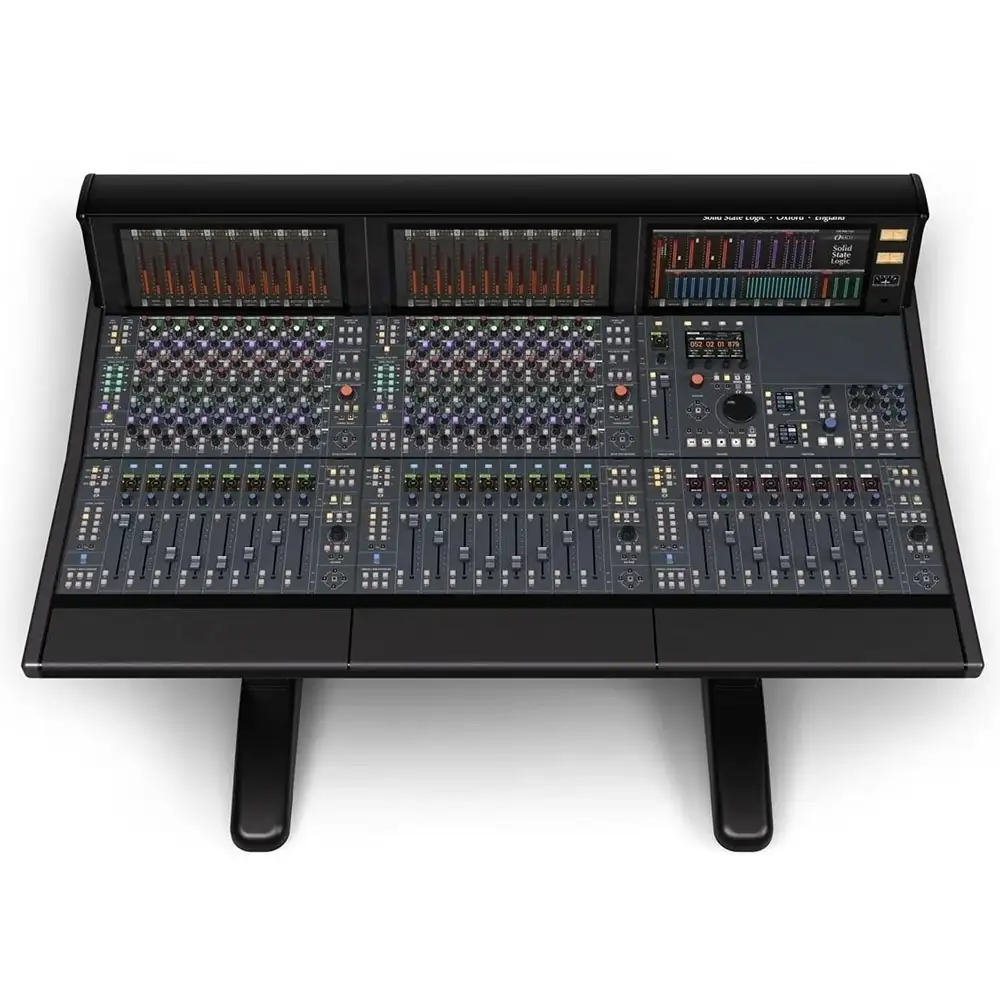
The Future Analogue channel strip
Oracle sports a traditional in-line design with separate
record and monitor paths, independent input gain and output level control, and
flexible processing routing. Combining SSL’s advanced analog circuit design
with the cherished features of classic SSL desks, Oracle’s stereo/dual-mono
Future Analogue channel strip offers a second line-level input and dedicated
controls for input gain, filter, aux sends, four-band parametric EQ, and an
ultra-premium 100mm motorized fader that can be assigned to either Small or
Large Fader paths. A high-resolution Channel Screen directly above the pan pot
keeps you status aware with level, pan, and track name information. At the top
of each channel strip is SSL’s next-generation PureDrive mic pre with dedicated
Drive control, delivering a robust 75dB of gain and a broad range of tonality.
In addition to clear Channel Screen info on the console
surface, when Channel Detail View is selected, the associated meter display
screen shows a breakout of all the channel parameters and routing, including
both Large and Small Fader paths. Detail View displays function interactively
with per-bay Navigator controls, providing “scroll and control” access to all
parameters, switch functions, and signal routing.
Enhanced 4-band parametric channel EQ
The 242 “Black Knob” E series EQ was SSL’s third console
channel equalizer design following the Brown Knob EQ and the Orange Knob 132
EQ. It improved on its predecessors in several ways: it was more powerful, with
an additional 6dB of cut and boost; it featured a steeper slope for the
highpass filter; and it had the capacity to switch the highpass and lowpass
filters out of circuit when not being used. However, beyond the spec sheet
improvements, the Black Knob EQ quickly gained notoriety for its open and transparent
sound, and engineers were struck by how generously they could apply EQ without
adding distortion to a signal, especially when cranking up the bass.
As implemented on each Oracle channel, an enhanced version
of SSL’s classic 4-band EQ offers switchable sonic characteristics, allowing
you to toggle between constant-Q for the more aggressive sound of the E series
and variable-Q for the smoother character of the G series. Both modes provide a
dedicated highpass filter, selectable HF and LF Shelf/Bell curves, and fully
parametric mid-frequency bands, delivering the coveted tonal signatures of
SSL’s renowned EQ design legacy and formidable tone-shaping versatility. The
EQs can be flipped between the small and large fader paths per channel, and can
also be linked in odd/even channel pairs, providing a single, easy-to-handle
control set for stereo sources. Each path has an independent, switchable, and
movable Insert point, and is equipped with an independent Direct Output for
direct stem or track output to your DAW.
The Center section: your mission control
SSL consoles are known for their comprehensive center
sections. Oracle carries on this tradition with high-resolution encoders and
displays that provide tactile control and visual feedback, putting you in
complete command of every session. Detail Views encompass not only channel
processing but also all processing within the Center section. They are
displayed when a Center section Detail View is activated. During this display,
the Main meters are reduced to allow focus on the console’s output buses.
Bus+: your one-stop shop for analog character
The center section compressor from SSL’s G series console
has achieved must-have status among audio professionals for its uncanny ability
to glue together a mix in a distinctly vital and musical way. Oracle vastly
expands on this concept with the Bus+. Constituting a modern update on this
essential tool, the Bus+ incorporates several coveted SSL analog processors
into one easy-to-use module, delivering the coveted glue and punch of the
classic mix bus compressor and so much more, all in one easy-to-use processor.
Offering four modes of operation, Low THD, Feed-Back, and “4K” (4000 series
console legacy) Saturation modes, plus coveted SSL analog processing such as
Dynamic EQ, Transient Expander, and more, the Bus+ is your one-stop shop for
analog character. The Bus+ adds outstanding flexibility to Oracle’s sonic
capabilities and is fully recallable, courtesy of ActiveAnalogue technology.
Comprehensive bus network
Oracle offers a comprehensive set of Track and Aux buses,
each featuring unique flexibility options. Its 10 Aux Buses may be
independently configured as either mono or stereo, while 16 Track buses can be
routed from both large or small fader channel paths. Routing can be mono, or
follow the channel to mix bus panning in odd/even track bus pairs to create
stereo group mixes.
Stereo group inputs
Oracle is spec’d with eight fader-controlled Stereo Group
inputs that can also pick up the 16 Track buses in pairs. Equipped with an
integrated width/image control and a switched insert, each Stereo Group input
can send to any of the Track, Aux, or Mix buses, as well as a dedicated Direct
Output. Mid-side (M-S) encoding prior to the Stereo Group Insert facilitates
independent processing of mid or side signals, while a selectable
post-insert-return M-S Decode circuit is onboard to decode M-S signals into stereo
group channels. The Stereo Group Inputs can each route to any of Oracle’s four
main Mix buses, Track buses, or any of the 10 Aux buses.
Control room monitoring and foldback
Oracle’s monitoring system upholds the legacy of previous
SSL consoles, which provided Main plus four alternative Stereo Monitor
sections. The fourth Alt monitor can be configured as a subwoofer/LFE output
with bass management capabilities. Remote Monitor Control functionalities grant
access to control of 3rd-party processing such as Dolby Atmos, enabling the
creation of a hybrid monitoring system optimized for immersive formats. The
Oracle system comprises three independent Foldback feeds, a surface-mounted
headphone output, and four stereo external source inputs, including a console
surface stereo input for direct injection (DI) of an instrument or connecting a
third-party Bluetooth receiver.
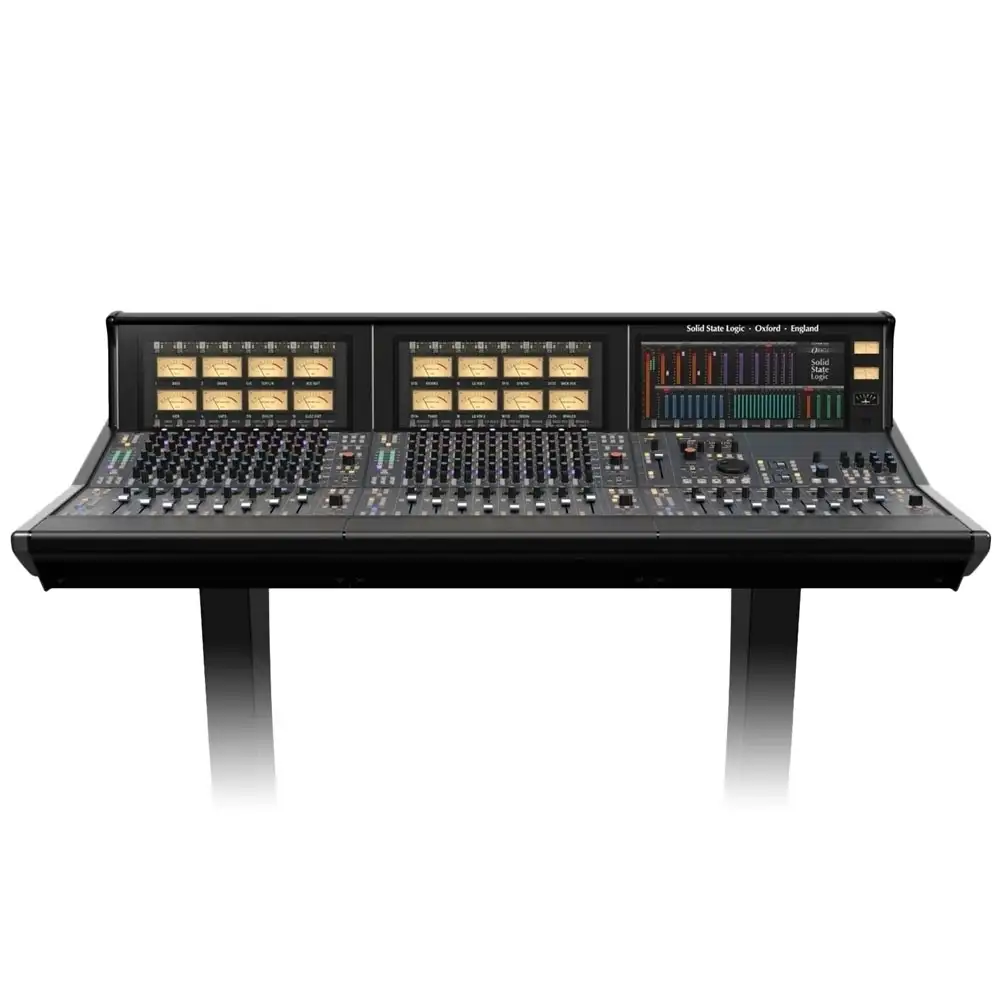
Sophisticated metering system
Oracle is designed to handle the complexities of modern
recording in all its myriad facets, and its sophisticated metering system
leverages modern display technology to keep you status savvy at all times. The
console’s high-resolution displays located above each bay logically convey
Channel EQ, Insert, and Filter configuration; Small and Large Fader routing and
level metering, Bus routing, and full track names are available on the
switchable classic VU or plasma-style metering, both of which are modeled on the
original 4000 series console metering options.
Ready for the most demanding projects
With up to 112 inputs at mixdown (for the 48-channel
configuration), Oracle can handle even the most demanding projects. Monster mix
sessions are easily accommodated with Oracle’s combination of mix paths from
both record and monitor faders, independent path inserts, and direct outputs,
as well as multiple parallel sub and stem mixes from the four stereo Main
buses, 10 Aux buses, 16 Track buses, and the 24-channel Oracle processing rack.
This all adds up to 48 mix paths, comprising 16 stereo sub-mixes and a primary
stereo bus, all controlled by faders. An additional rack of 24 in-line channels
doubles the channel processing capacity, enabling a total of 96 mix paths.
Oracle Rack
The Oracle Rack, which houses all analog circuitry, is a key
element of Oracle’s refined architecture. A typical Oracle system will have two
processing racks, which can be located in your control room, adjacent to or
away from the console, or even in a separate machine room. One rack handles the
center section processing; the second is dedicated to the channels. A system
might have one or two channel racks, depending on your console’s channel
specification, to create a system of two or three racks. The racks are actively
cooled, but maintain an acoustic noise floor below NR25.
Advanced DAW control
Since Solid State Logic’s AWS series, the company’s
console-integrated DAW control has allowed engineers to instantly shift from
the analog world to hybrid and fully in-the-box mixing, while benefiting from
the efficiencies and sonic richness of a proper analog mixing console. With a
single button press, you can switch Oracle’s surface faders between Analogue
Processing and DAW Control modes using the Focus key. This function can be
executed on a per-bay basis, providing a convenient way to deploy Analogue Processing
and DAW Control modes in adjacent console bays.
Immersive-format compatibility
SSL plans to extend Oracle's remote-control capability to
3rd-party immersive monitoring solutions such as Dolby Atmos Renderer. In
practice, this mutes the console's analog stereo monitoring and passes surface
monitoring control messages to the immersive-format renderer being used,
opening up Oracle's superior analog processing to the gamut of current and
future immersive music and film sound formats.
O-Control
The O-Control application suite is a cross-platform (macOS
and Windows) suite of control, configuration, and session management
applications for Oracle. The apps can run standalone/offline and in this way
can be used as tools to create, edit, and update project information for Oracle
consoles. They can also run in tandem with the console to assist with session
configuration and management tasks such as saving and loading presets, creating
snapshots, and logging project information. Running under O-Control is the
O-Setup app, which manages the console settings, and O-Session, which manages
the saving and loading of projects, presets, and snapshots, as well as the
control and inspection of console processing sections. Lastly, O-View shows an
overview of the console at its current state.
Templates get you up and running fast
A byproduct of SSL’s advanced ActiveAnalogue technology is
Oracle’s ability to create project Templates that recall all settings and
routing across the board. Every producer and engineer has a particular work
methodology, and Oracle’s Templates serve as convenient starting points for
specific recording and mixing applications. In tandem with the O-Control
application, Oracle makes console setup quick and easy, allowing your sessions
to get underway faster than ever before!
The Solid State Logic legacy
Since its founding by Colin Sanders in 1969, Solid State
Logic has followed a design philosophy that prioritizes the needs of artists,
engineers, and producers. The company’s products facilitate creativity by
removing technical impediments and streamlining workflows. Firmly ensconced in
the pantheon of pro audio greats, SSL helped shape the history of pro audio.
Impressively, it continues to innovate, bringing its uncompromising quality and
signature sonics to a new generation of artists and creators. Sweetwater is
proud to offer you SSL’s pedigreed line of consoles, signal processors, and
audio interfaces.
Solid State Logic Oracle Features:
- Compact
large-format in-line analog mixing console
- Available
in 24- and 48-channel configurations
- Flexible
channel architecture with up to 112 inputs at mixdown
- Advanced
SSL circuitry, controlled by ActiveAnalogue technology
- Next-gen
PureDrive preamps with Drive control
- 4
Stereo Mix buses, 16 Track buses, 10 Aux buses, 16 Stereo Flex Groups
- Enhanced
SSL 4-band parametric EQ with switchable E/G Series curves
- Integrated
Bus+ and Dynamic EQ processors
- SSL
Dynamic Automation system; ultra-premium 100mm motorized faders
- Complete
recall of all gain, routing, pan, and processing settings
- Instant
switching between tracking, overdubbing, and mixing configurations
- Small
and Large Fader paths with assignable EQ and Insert points
- Versatile
monitoring with multiple stereo and immersive mixing options
- Informative
VU or Plasma-style metering with dynamic Detail View
- Advanced
DAW control with SSL 360 integration
- O-Control
app for offline session preparation and console configuration
- 13U,
19-in. racks house all analog circuity


